Trade Fair Report · Natural Stone · Turkey
What Did the 2026 Izmir Marble Fair Reveal About Turkey's Stone Power and China's Equipment Push?
A first-hand walk through the halls where 40% of the world's marble reserves meet global buyers — and where Chinese quarry equipment is quietly becoming the industry standard.
🕑 14 min read · Updated: August 28, 2026
By Mike Chen, Technical Director at Xiamen Yinxiang Artificial Marble Co., Ltd. — 15 years in Fujian's stone industry.
Key Takeaways
Turkey holds roughly 40% of the world's natural stone reserves, and the Izmir Marble Fair is where that reserve depth meets more than 170 export markets each year.
Beige marble and travertine remain Turkey's two export workhorses because their warm, light tones fit both European renovation and Gulf luxury design.
The fair confirmed a two-way trade: Turkish blocks ship east to China for processing, while Chinese quarry and processing equipment ships back west to Turkey.
Chinese equipment brands are winning Turkish orders on price-performance and local after-sales service — not on upfront cost alone.
For large projects, buyers increasingly run natural Turkish stone and engineered marble side by side, because engineered products solve the color-consistency problem natural stone cannot.
The 2026 Izmir Marble Fair confirmed two things I already suspected from fifteen years in this industry: Turkey's stone power is built on reserves, and China's rising power is built on equipment. Walk the beige aisle and you see the world's marble supply; walk the machinery hall and you see China's industrial future being installed, one gang saw and wire saw system at a time. The two are not competing — they are now so interlocked that a Turkish quarry owner and a Fujian factory manager are two halves of the same supply chain. Here is what the fair actually revealed, angle by angle.
How Big Is Turkey's Marble Position, and Why Does the Fair Matter?
Turkey holds approximately 40% of the world's natural stone reserves, and it has turned that geological luck into one of the largest natural stone export industries on earth. According to the Istanbul Mineral Exporters' Association (IMIB), Turkey ships natural stone to more than 170 countries, and its annual export value has settled in the range of roughly US$2 billion — a figure that makes it one of the top three stone exporters globally, alongside China and Italy. Cross-check the same flows on ITC Trade Map, and the ranking holds: Turkey consistently appears in the global top three for dimensional natural stone exports by value.
The Izmir Marble Fair matters because it is the physical meeting point where that reserve base is priced, sampled, and contracted. Held in the Aegean port city that anchors Turkey's western quarry belt, the fair pulls together quarry owners from Afyon, Denizli, Burdur, Elazig, and Mugla, alongside block traders, processing plants, and a growing number of machinery suppliers. For an overseas buyer, one day on that floor replaces a month of scattered supplier visits.
Why the Aegean region specifically? Because Turkey's marble belt clusters around Izmir for a reason: proximity to port, which is the same geographic logic that built Fujian's stone power around Xiamen. Quarries want to be near deep-water loading, and exporters want short haulage from pit to vessel. When you see that pattern repeat across two of the world's three stone superpowers, you have found a structural truth, not a coincidence.
What Trends Dominated the 2026 Fair Floor?
The dominant story on the floor was continuity with a sustainability edge: beige marble and travertine still rule, but buyers are asking harder questions about quarrying practice and processing waste. Three trends stood out to me in two days of walking the halls.
First, the beige aisle was packed. Burdur beige, Crema, and their near-relatives still attract the longest queues because warm, light stone is the safest default in European renovation and Gulf hospitality. Design trends come and go, but beige has been the world's default "safe luxury" tone for thirty years, and nothing at the fair suggested that is changing.
Second, travertine is quietly becoming the volume story, not the niche story. Denizli travertine — filled and honed — now appears in every mid-range facade and flooring specification across the Middle East. Because travertine is softer and cheaper to quarry and finish than crystalline marble, it has become the workhorse for developers who want a natural stone look at a concrete-adjacent budget.
Third, sustainability language has moved from brochure copy to booth conversations. Quarry operators are talking about block recovery rate, water recycling in processing, and reduced-waste diamond tooling — not because regulators forced them, but because European and Gulf specifiers now ask for it in tender documents. The suppliers who could answer those questions with numbers had the busiest booths.
The Two-Way Trade: Turkish Blocks East, Chinese Equipment West
The most consequential observation at the fair was not any single product — it was the direction of the traffic between two continents. Turkey and China are no longer buyer and seller in one direction; they are trading complementary strengths in both directions at once.
Eastbound, Turkish marble blocks — beige, travertine, Elazig cherry, and Milas — ship to Chinese ports like Xiamen, where factories saw them into slabs and finished pieces for re-export or domestic projects. Because China has the world's densest stone processing capacity and Turkey has the world's deepest marble reserves, the two fit together the way iron ore fits a steel mill. The block trade is now a stable, high-volume channel rather than an opportunistic one.
Westbound, Chinese equipment flows the other way. Gang saws, polishing lines, diamond segments, and quarry wire saw systems are now standard fixtures in Anatolian quarries and factories. This is the part that most Western trade reporting understates: China is not just selling finished goods into Turkey's neighborhood — it is selling the machines that let Turkey process its own stone more efficiently.
My honest read: the deepest long-term signal at Izmir this year was not marble — it was the equipment hall filling up with Chinese brands. That is a structural shift that will reshape who captures processing margin in this industry over the next decade.
Why Do Buyers Keep Choosing Turkish Beige and Travertine?
Buyers keep choosing Turkish beige and travertine because these materials sit in the narrow zone where "premium look," "reliable supply," and "reasonable cost" all overlap. That overlap is rarer than it sounds, and Turkey owns it more completely than any other source.
Beige marble gives architects a warm, light base tone that photographs well and forgives a wide range of furniture and lighting choices. Because beige reflects light without the high-contrast veining that dates a room, it functions as a design "safe harbor" for projects that need to look expensive for twenty years. That is a commercial property, not just an aesthetic one.
Travertine's appeal is different. Its matte, textured surface hides wear and fingerprints far better than polished marble, which makes it the preferred choice for hotel floors, spa environments, and outdoor facades. Because travertine ages gracefully — developing a soft patina instead of showing scratches — it suits the high-traffic, long-lifecycle projects that now dominate Gulf and Mediterranean construction.
Here is a quick-reference of the Turkish varieties that carried most of the export volume at this year's fair:
| Variety | Source Region | Type | Typical Use |
|---|---|---|---|
| Burdur Beige | Burdur | Beige marble | Interior slabs, cladding, book-match walls |
| Crema Nova | Afyon / Burdur | Beige marble | Flooring, bathrooms, retail interiors |
| Denizli Travertine | Denizli | Travertine | Facades, hotel floors, outdoor paving |
| Elazig Cherry | Elazig | Dark red/burgundy marble | Feature walls, lobbies, statement cladding |
| Portoro | Mugla region | Black marble with gold veining | Luxury countertops, bar tops, feature panels |
How to use this table: these are the varieties with the deepest and most consistent supply, which matters more than raw beauty when a project spans months. Choose by application first — a stone that is beautiful in a showroom but unavailable at scale will blow up your schedule. Deep, consistent supply is Turkey's real competitive moat.
Chinese Equipment Goes Overseas: What Turkish Buyers Actually Want
Chinese stone equipment has moved from "budget alternative" to "standard choice" in Turkish quarries and factories, and the reason is service, not just price. This is the angle most coverage misses: the machinery story at Izmir is about the after-sale, not the sticker price.
Turkish quarry operators are pragmatic buyers. They test equipment on three criteria in a fixed order: output per shift, downtime between failures, and the speed of a service call. Because Chinese equipment brands now ship spare parts and technicians on the same freight lanes that carry Turkish marble to China, their after-sales response in Anatolia is often faster than that of legacy European suppliers. That logistical symmetry — empty return containers heading back to Turkey — is an invisible advantage that compounds over time.
What are they buying? Gang saws for block slabbing, automatic polishing lines for slab finishing, diamond segment tooling for the cutters, and wire saw systems for quarry extraction. I have deliberately avoided re-litigating the wire saw technology itself here — that is its own deep topic — but the on-the-ground fact is simple: Chinese extraction and processing machinery is now as common in Anatolian quarries as Italian machinery was a generation ago.
The lesson for anyone selling into this industry, on either side: the stone trade is becoming an equipment trade. The companies that control the machines will increasingly control the margin — in Turkey, in China, and everywhere the two supply chains meet.
~40% of world natural stone reserves held by Turkey (IMIB)
170+ countries reached by Turkish stone exports
~US$2B annual Turkish natural stone export value
Figures are directional, sourced from IMIB export reporting and trade fair documentation. Confirm current-year figures with the exporter before contracting.
A Sourcing Playbook for Turkish Stone
Whether you are buying Turkish blocks for processing in China, or finished slabs for a project in Europe or the Gulf, the same five steps de-risk the purchase. I have watched too many first-time buyers pay "fair premium" for stone they could have sourced at a fraction of the risk with a bit of structure.
Decide block or slab before you negotiate. Blocks suit buyers with their own sawing capacity; slabs suit buyers who need finished material. The wrong starting point is the single most expensive sourcing mistake.
Lock the grade in writing. Specify the commercial grade (first choice vs. standard), the acceptable vein range, and the thickness tolerance. "Nice beige" is not a specification; a written grade is.
Inspect at the quarry yard, not the showroom. Send a third-party inspector to photograph the actual blocks or the slab run before shipment. Showroom samples flatter; quarry reality decides your project.
Plan the port leg deliberately. Blocks typically move from Izmir or Aliaga ports; transit to Xiamen runs roughly 20–30 days. Consolidate to fill containers and cut per-ton freight.
Hedge natural variation with an engineered line. For large projects, spec engineered marble for the surfaces where consistency is non-negotiable, and reserve natural Turkish stone for the features where character earns its keep.
The Consistency Gap — and Where Engineered Stone Fills It
Natural Turkish marble is extraordinary precisely because it varies, and that variation is also its biggest liability on large projects. This is the honest, unglamorous truth of the trade: no two blocks of Burdur beige are identical, and across 10,000 square meters of cladding, tonal drift is not a defect — it is a physical certainty.
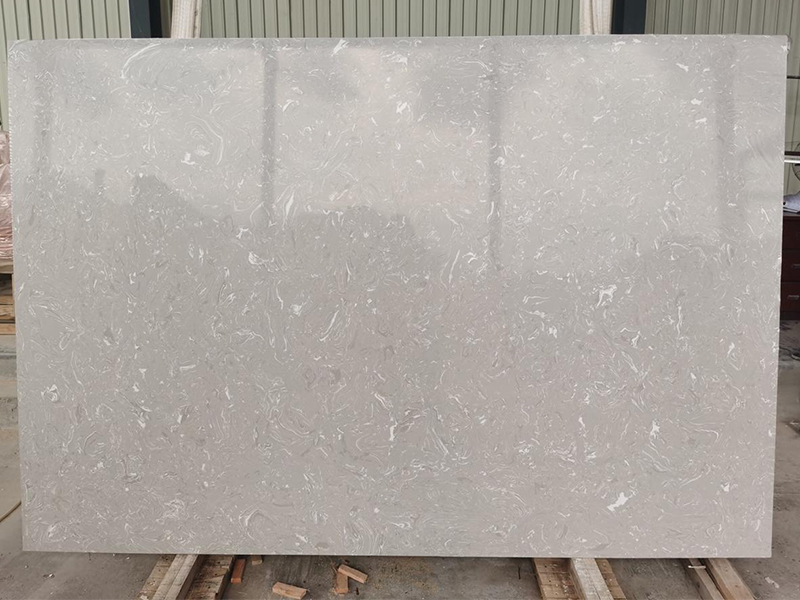
That is exactly the problem engineered marble was built to solve. Produced with controlled recipes and repeatable veining, engineered marble delivers the warm beige or dramatic black-gold look of Turkish classics without the block-to-block lottery. Because engineered production is recipe-driven, it gives architects something natural stone cannot promise: the same wall in the render and in the building.
This is not an argument against Turkish stone — it is a complement. The buyers I advise run both: natural Turkish material for feature walls and statement pieces, engineered marble for the large, repeatable surfaces where consistency protects the schedule and the budget. Our own factory in Xiamen produces engineered versions of the very classics this fair is known for — including the Burdur Bottocino (YXB-019), a warm beige engineered marble that mirrors the Burdur look with recipe-consistent tone, and the Royal Portoro (YXY-021), a full-body black engineered marble with gold veining for the drama of Turkish Portoro without the supply risk.
My rule after fifteen years: buy natural stone for character, buy engineered stone for consistency, and buy both from a supplier who understands the difference. The 2026 Izmir fair showed me, again, that the two are not rivals — they are two tools in the same kit.
Planning a Project With Turkish Stone or Engineered Marble?
Tell us your application, target tone, dimensions, and delivery port. We will benchmark natural Turkish stone against our engineered equivalents and respond with options, pricing, and lead times within 24 hours.
✉ Send Your Inquiry →Frequently Asked Questions
How much marble does Turkey export every year?
Turkey is one of the world's top three natural stone exporters, shipping roughly US$2 billion of marble, travertine, and other stone each year to more than 170 countries. According to IMIB, Turkey holds approximately 40% of the world's natural stone reserves, which gives its exporters a depth and variety of supply that few competitors can match.
Why is Turkish marble so popular with international buyers?
Because Turkey combines enormous reserve depth with warm, light, design-friendly tones that fit both European renovation and Gulf luxury projects. Its beige marbles and travertines are among the most specified natural surfaces in the world, and Turkish suppliers have built strong logistics to Europe, the Middle East, and China.
What is the difference between beige marble and travertine?
Beige marble is a crystalline, metamorphic stone that takes a high polish and is used for slabs, tiles, and cladding. Travertine is a sedimentary limestone formed by mineral springs, characterized by natural pitting and a matte, porous surface; it is usually filled and honed for flooring and facades. Travertine is generally softer and more affordable than polished marble.
Is Chinese stone equipment used in Turkish quarries?
Yes. Chinese quarry and processing equipment — including gang saws, polishing lines, diamond tools, and wire saw systems — is now common in Turkish quarries and factories. Turkish buyers select it on price-performance and local after-sales support, which has made Chinese equipment a standard choice across the Anatolian quarry belt.
Which Turkish marble varieties should I consider for my project?
For warm, light interiors consider Burdur Beige or Crema varieties; for large-format cladding and book-match walls consider Elazig Cherry or Milas; for a dramatic black-with-gold-vein statement consider Portoro. For matte, textured floors and facades, Denizli travertine is the industry workhorse. Choose by application, not by color alone.
How do I source Turkish marble blocks for processing in China?
Buy blocks through a Turkish quarry operator or a licensed export agent, specify the block size and grade in the contract, and arrange third-party inspection at the quarry yard before shipment. Blocks typically ship from Izmir or Aliaga ports to Xiamen in about 20–30 days, after which local Chinese factories saw and finish them.
Why would I choose engineered marble over natural Turkish marble?
Because natural stone varies block to block, while engineered marble is produced with controlled recipes that deliver repeatable color and veining at scale. For large projects where tonal consistency and predictable fabrication speed matter, engineered versions of Turkish classics — such as Burdur beige or Portoro — remove the supply and consistency risk of natural material.
📅 Published: 2026-08-28 🔄 Last verified: 2026-08-28 🌐 Covers: Turkey marble trade, Izmir Marble Fair, China equipment export